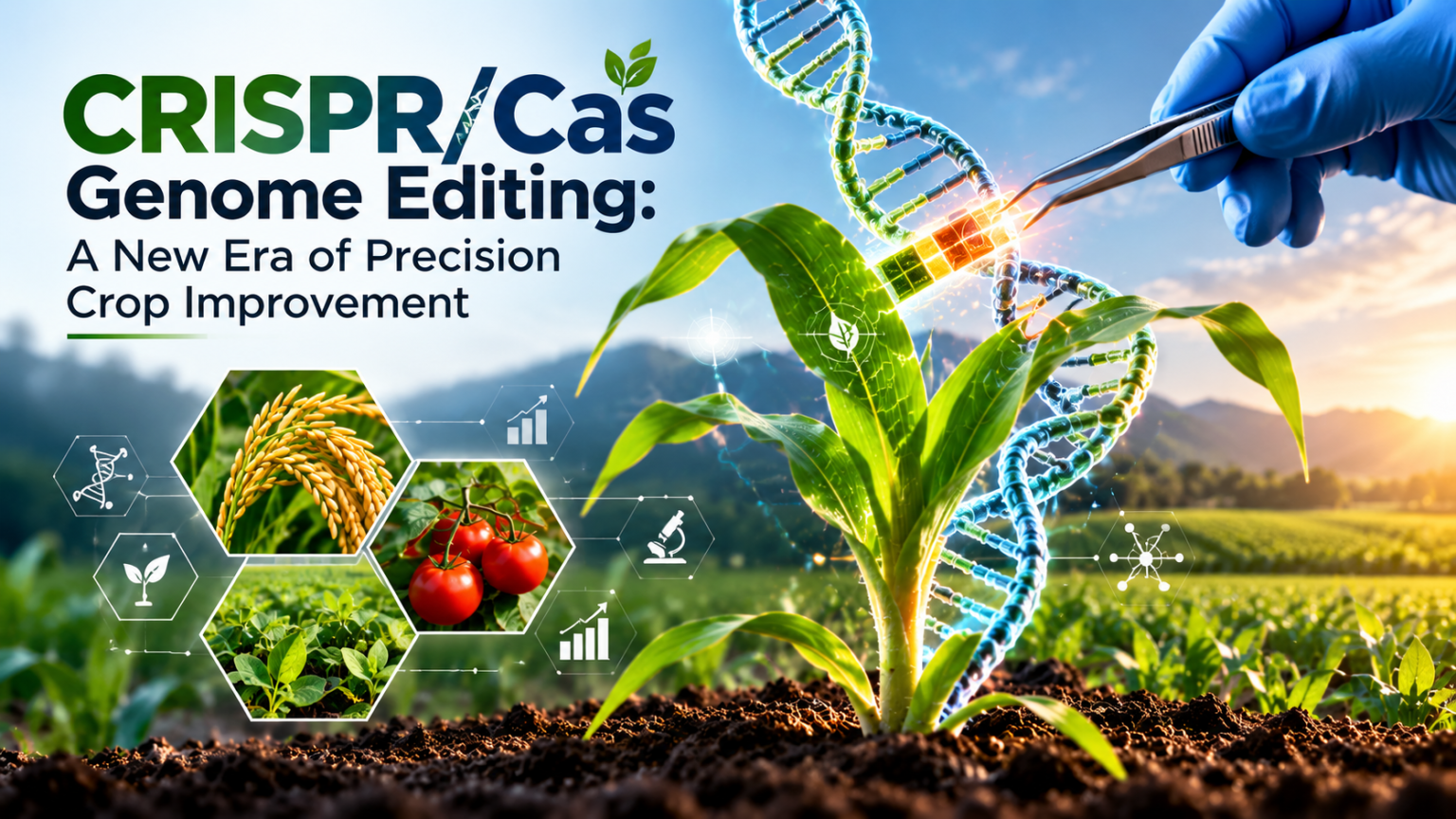
CRISPR/Cas Genome Editing: A New Era of Precision Crop Improvement

Article Summary
CRISPR-Cas is an adaptive immune system existing in most bacteria and archaea, preventing them from being infected by phages, viruses and other foreign genetic elements [13], [14]. It is composed of CRISPR repeat-spacer arrays, which can be further transcribed into CRISPR RNA (crRNA) and trans-activating CRISPR RNA (tracrRNA), and a set of CRISPR-associated (cas) genes which encode Cas proteins with endonuclease activity [15].
Introduction
Agriculture is facing unprecedented challenges in the twenty-first century. Rapid population growth, climate change, declining natural resources, emerging crop diseases, and increasing pressure on food systems have created an urgent need for more productive, resilient, and sustainable agricultural practices. Conventional plant breeding has contributed significantly to agricultural development, but improving complex traits through traditional methods can be time-consuming and constrained by the genetic diversity available within breeding populations. In this context, CRISPR/Cas genome editing has emerged as a powerful technology for precision crop improvement.
CRISPR/Cas genome editing enables researchers to make targeted changes to specific DNA sequences associated with important plant characteristics. These modifications can help develop crops with improved yield potential, enhanced nutritional quality, greater resistance to pests and diseases, and better adaptation to environmental stresses. Unlike conventional genetic engineering, some genome-editing approaches can produce targeted changes without retaining foreign DNA in the final plant.
Although CRISPR/Cas is not a replacement for conventional breeding, it offers plant breeders an additional tool to accelerate genetic improvement. Its integration with genomics, molecular breeding, speed breeding, and advanced phenotyping could reshape crop development and contribute to more sustainable food production.
1. Understanding CRISPR/Cas Genome Editing
CRISPR stands for Clustered Regularly Interspaced Short Palindromic Repeats, while Cas refers to CRISPR-associated proteins that perform specific functions within the system. The technology was adapted from a natural defence mechanism used by bacteria and archaea to recognise and respond to invading genetic material.
In the widely used CRISPR/Cas9 system, a guide RNA directs the Cas9 protein towards a complementary DNA sequence. Once the target is recognised, Cas9 creates a cut in the DNA. The plant cell then repairs the break through its natural DNA repair mechanisms. Researchers can use this process to disrupt a gene, alter its function, or introduce a desired genetic change.
Depending on the editing system and repair mechanism involved, researchers can achieve different types of genetic modifications. These may include gene knockouts, targeted substitutions, small insertions or deletions, and changes to regulatory regions.
The technology has also expanded beyond conventional Cas9 editing. Base editing can change certain individual DNA bases without creating a conventional double-strand break, while prime editing offers greater flexibility for introducing specific genetic changes. These newer approaches are broadening the potential applications of genome editing in crop improvement.
2. Why Is CRISPR/Cas Genome Editing Important for Crop Improvement?
The major significance of CRISPR/Cas lies in its ability to modify selected genetic targets with a high degree of precision. Conventional breeding involves crossing plants and selecting desirable offspring over several generations. Although this approach is highly effective, it can also transfer unwanted genetic material along with the desired trait.
Genome editing provides an opportunity to make a specific change while retaining much of the genetic background of an established variety. This is particularly useful when breeders want to improve an elite crop variety that already possesses desirable characteristics such as high yield, preferred grain quality, or adaptation to a particular environment.
CRISPR/Cas may also shorten the time required to introduce particular traits. Instead of waiting for naturally occurring variation to be identified and transferred through repeated crossing, researchers can target genes whose functions are already understood.
However, precision does not mean simplicity. The performance of an edited crop depends on the genetic background, environmental conditions, interactions among genes, and the biological function of the targeted gene. Therefore, genome editing works best when combined with conventional breeding, field evaluation, and detailed knowledge of crop genetics.
3. Major Applications of CRISPR/Cas in Crop Improvement
CRISPR/Cas has potential applications across almost every major area of plant improvement.
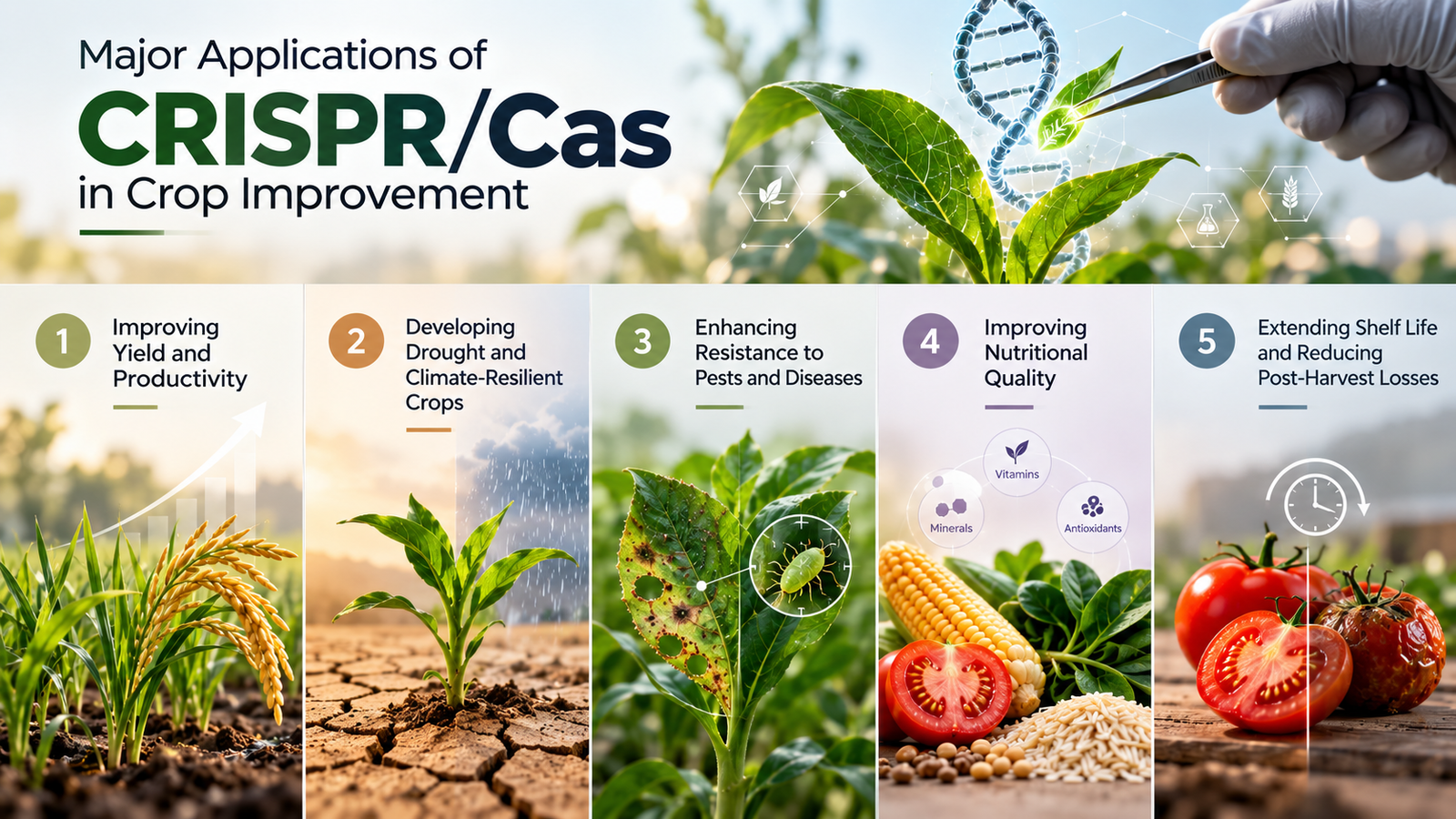
3.1 Improving Yield and Productivity
Increasing crop productivity remains one of the most important objectives of agricultural research. Genome editing can help researchers investigate and modify genes involved in plant architecture, flowering time, tillering, grain development, and resource allocation.
In crops such as rice, wheat, and maize, researchers are exploring genome-editing approaches to improve yield-related characteristics. Editing specific genes may help produce plants with more favourable architecture or improved reproductive performance.
However, yield is a complex trait controlled by numerous genes and strongly influenced by environmental conditions. Therefore, editing one gene does not automatically result in higher yield under every growing condition. Field testing across different environments remains essential.
3.2 Developing Drought and Climate-Resilient Crops
Climate change is placing increasing pressure on agricultural systems through drought, heat, salinity, irregular rainfall, and other environmental stresses. CRISPR/Cas genome editing provides researchers with an opportunity to modify genes involved in plant stress responses.
Potential targets include genes associated with:
- Water-use efficiency and drought response
- Root growth and development
- Heat-stress tolerance
- Salt-stress responses
- Plant hormone signalling
- Cellular protection under environmental stress
Developing climate-resilient crops could become increasingly important in regions where water availability is uncertain or temperatures are rising. Nevertheless, stress tolerance must be evaluated alongside yield, maturity, quality, and other agronomic characteristics.
3.3 Enhancing Resistance to Pests and Diseases
Crop diseases and insect pests can cause substantial yield and economic losses. Genome editing offers new strategies for improving plant defence by modifying genes involved in pathogen recognition and plant immunity.
One particularly promising approach is the modification of susceptibility genes. Some pathogens depend on particular plant genes to establish infection. If such genes can be modified without negatively affecting the plant, researchers may be able to reduce disease susceptibility.
CRISPR/Cas is therefore being investigated for resistance against bacterial, fungal, and viral diseases in different crops. Such approaches could complement conventional resistance breeding and integrated pest management.
3.4 Improving Nutritional Quality
Food quality and nutrition are becoming increasingly important components of crop improvement. Genome editing can be used to modify genes involved in the production or accumulation of vitamins, minerals, proteins, oils, amino acids, and other metabolites.
Potential objectives include:
- Increasing concentrations of desirable nutrients
- Modifying the composition of edible oils
- Improving protein or amino-acid profiles
- Reducing undesirable compounds
- Modifying starch and carbohydrate characteristics
These applications could contribute to both human nutrition and the development of crops with improved industrial or processing properties.
3.5 Extending Shelf Life and Reducing Post-Harvest Losses
A significant proportion of agricultural production is lost after harvest because of deterioration, ripening, bruising, microbial damage, and unsuitable storage conditions.
CRISPR/Cas can be used to investigate genes involved in fruit ripening, softening, browning, and other post-harvest processes. By modifying selected genes, researchers may be able to develop crops that maintain desirable quality for longer periods.
Tomato is one example where genome-editing research has examined genes associated with fruit development and ripening. Similar approaches may have applications in other fruits and vegetables.
However, extending shelf life should not come at the expense of flavour, nutritional value, texture, or normal plant development.
4. Examples of CRISPR-Based Crop Research
CRISPR/Cas genome editing has been investigated in a wide range of economically important crops, including rice, wheat, maize, tomato, soybean, potato, and canola.
In rice and wheat, researchers have explored gene editing for disease resistance, plant architecture, grain characteristics, and tolerance to environmental stresses. In tomato, genome editing has been used to investigate traits associated with fruit quality, plant growth, and domestication. In soybean and potato, researchers have examined applications involving oil composition, nutritional characteristics, and other quality-related traits.
An important example is the editing of plant susceptibility genes to improve disease resistance. Rather than introducing a resistance gene from another species, researchers can sometimes modify an existing plant gene that a pathogen requires for successful infection. This illustrates an important feature of genome editing: it can use existing biological knowledge to make targeted changes within a crop’s own genome.
At the same time, it is important to distinguish research-stage achievements from commercially available crop varieties. A successful laboratory experiment is only one step in the crop-development process. Stable inheritance, field performance, food or feed safety assessment where applicable, regulatory approval, seed production, and farmer acceptance must also be considered.
5. CRISPR/Cas Versus Conventional Plant Breeding
Conventional plant breeding remains the foundation of modern crop improvement. It enables breeders to combine favourable traits, exploit genetic diversity, and develop varieties adapted to specific environments.
The major difference is that CRISPR/Cas allows researchers to target a known DNA sequence directly. Instead of depending entirely on naturally occurring variation, researchers can make a specific genetic modification based on knowledge of gene function.
The two approaches should therefore be viewed as complementary technologies rather than competing systems.
A modern breeding programme may combine:
- Conventional crossing and selection
- Marker-assisted selection
- Genomic selection
- CRISPR/Cas genome editing
- Speed breeding
- High-throughput phenotyping
Such integration can increase the efficiency of developing improved varieties while retaining the strengths of conventional breeding.
6. Major Advantages of CRISPR/Cas
The growing interest in CRISPR/Cas is largely due to its precision, flexibility, and expanding range of applications. Some of its most important advantages include:
- Targeted modification: Researchers can focus on specific genes or DNA regions associated with a desired trait.
- Breeding efficiency: Particular genetic changes can sometimes be introduced faster than through repeated conventional crossing.
- Reduced linkage drag: Targeted editing may help improve a specific trait without transferring large segments of unwanted genetic material.
- Multiplex editing: Several genes can potentially be modified simultaneously, which is useful for complex traits.
- Trait diversification: Different types of edits can be used to explore gene function and develop alternative versions of a crop trait.
- Compatibility with modern breeding: Genome editing can be combined with genomics, marker-assisted selection, and speed breeding.
These advantages make CRISPR/Cas particularly valuable for precision improvement of established crop varieties.
7. Challenges and Limitations
Despite its enormous potential, CRISPR/Cas is not without limitations. The technology must be evaluated carefully before edited crops are released for cultivation or consumption.
The major challenges include:
Off-target effects: Unintended genetic changes may occur at DNA sequences that resemble the intended target. Advances in guide-RNA design and sequencing are helping researchers reduce and detect such changes.
Transformation and regeneration: Some important crops and elite varieties are difficult to genetically transform or regenerate in tissue culture. This remains a major technical bottleneck.
Complex traits: Characteristics such as yield, drought tolerance, and climate resilience are controlled by many genes and influenced strongly by environmental conditions. Editing a single gene may therefore provide only a limited improvement.
Regulatory differences: Countries differ in how they classify and regulate genome-edited crops. Regulatory frameworks may depend on the type of genetic change and whether foreign DNA is present in the final product.
Public acceptance: Scientific performance alone does not guarantee adoption. Consumers and farmers need transparent information about how genome-edited crops are developed and evaluated.
Ecological considerations: The potential effects of edited crops on ecosystems, biodiversity, gene flow, and non-target organisms must be considered on a case-by-case basis.
8. Future Prospects of Genome Editing in Agriculture
The future of CRISPR/Cas crop improvement is likely to be shaped by its integration with other advanced technologies. Improvements in genome sequencing and functional genomics are making it easier to identify genes associated with important traits.
At the same time, artificial intelligence and machine-learning approaches may help researchers analyse large genomic datasets and identify promising targets for editing. Precision phenotyping can then be used to evaluate how edited plants perform under controlled and field conditions.
Base editing and prime editing are particularly promising because they expand the range of genetic modifications that can be achieved. Multiplex editing may also become increasingly useful for complex traits involving several genes.
Speed breeding could further accelerate the development of edited lines by reducing generation time. When these technologies are integrated into a single breeding pipeline, the process of identifying a useful gene, making a targeted modification, evaluating the resulting plant, and developing an improved variety could become considerably more efficient.
For countries such as India, genome editing could have particular relevance for developing crops adapted to drought, heat, salinity, emerging diseases, and other region-specific agricultural challenges. However, successful deployment will require strong scientific infrastructure, appropriate regulatory systems, farmer participation, and equitable access to improved technologies.
Conclusion
CRISPR/Cas genome editing represents a major step towards precision crop improvement. By allowing researchers to make targeted changes in plant genomes, it provides new opportunities to improve yield, disease resistance, climate resilience, nutritional quality, and post-harvest characteristics.
Its greatest strength lies not in replacing conventional breeding but in complementing it. When combined with genomics, speed breeding, precision phenotyping, and advanced computational tools, CRISPR/Cas could significantly accelerate the development of crops suited to future agricultural challenges.
At the same time, responsible application is essential. Off-target effects, transformation limitations, complex genetic interactions, ecological considerations, regulatory differences, and public acceptance must all be addressed through rigorous scientific evaluation.
The future of crop improvement is therefore unlikely to depend on a single technology. Instead, it will emerge from the integration of traditional breeding with increasingly precise molecular tools. In that broader transformation, CRISPR/Cas genome editing has the potential to become one of the most important technologies shaping the next generation of agriculture.
Key takeaways
- CRISPR/Cas is a precision genome-editing technology that allows targeted modifications of plant DNA.
- It can contribute to improvements in yield, disease resistance, drought tolerance, nutritional quality, and shelf life.
- Base editing and prime editing are expanding the range of genetic modifications possible.
- CRISPR/Cas genome editing works best as a complement to conventional plant breeding, rather than as a replacement.
- Important challenges include off-target effects, transformation difficulties, complex traits, regulation, public acceptance, and ecological assessment.
- Combining genome editing with AI, genomics, speed breeding, and precision phenotyping could accelerate future crop improvement.
- Responsible deployment could contribute to climate-resilient agriculture and long-term food security.
Frequently asked questions
1. What is CRISPR/Cas genome editing in crop improvement?
CRISPR/Cas genome editing is a biotechnology that allows scientists to make targeted changes to DNA sequences in crop plants. It can be used to modify genes associated with yield, disease resistance, stress tolerance, nutritional quality, and other agricultural traits.
2. How does CRISPR/Cas9 work in plants?
CRISPR/Cas9 uses a guide RNA to direct the Cas9 protein to a specific DNA sequence. Cas9 cuts the target DNA, after which the plant's natural DNA-repair mechanisms repair the break. This process can result in targeted genetic changes.
3. What are the main applications of CRISPR in agriculture?
The major applications include developing disease-resistant crops, improving drought and heat tolerance, modifying plant architecture, enhancing nutritional quality, changing oil and starch composition, and improving the shelf life of fruits and vegetables.
4. Is CRISPR better than conventional plant breeding?
CRISPR offers greater control over specific genetic changes and can accelerate the improvement of selected traits. However, conventional breeding remains essential for combining complex traits and exploiting genetic diversity. The two approaches are best considered complementary.
5. Can CRISPR produce crops without foreign DNA?
Some CRISPR-based approaches can produce edited plants without retaining foreign DNA in the final plant. Whether this occurs depends on the editing method and how the editing components are delivered. The regulatory treatment of such crops varies between countries.
6. What are the limitations of CRISPR/Cas in crop improvement?
The main limitations include potential off-target changes, difficulty transforming some crops, challenges associated with complex traits, differences in national regulatory frameworks, and questions concerning public acceptance and environmental impact.
7. Are CRISPR-edited crops safe?
The safety of a genome-edited crop depends on the specific genetic modification, the crop, and its intended use. Appropriate molecular, compositional, food-safety, and environmental assessments should be carried out according to relevant scientific standards and regulations.