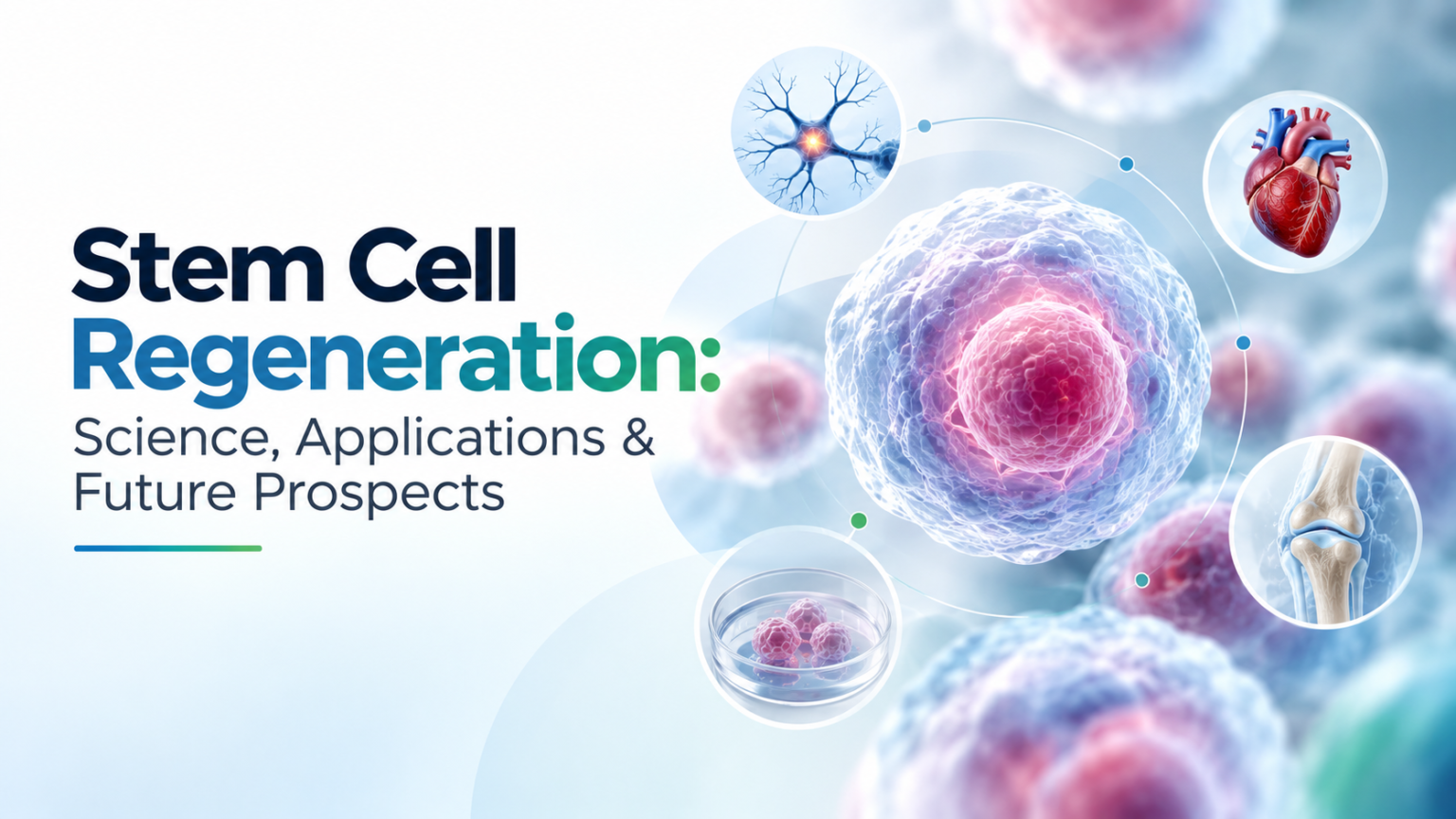
Stem Cell Regeneration: Science, Applications & Future Prospects

Article Summary
Different types of stem cells have different regenerative capabilities. Another important category is induced pluripotent stem cells (iPSCs). Stem-cell-derived cells and engineered tissue constructs are being studied as potential approaches for restoring damaged cartilage and improving tissue repair.
Introduction
The human body has a remarkable ability to repair and replace damaged cells, but this regenerative capacity varies considerably among tissues. While some organs can regenerate relatively efficiently, others have a limited ability to replace cells lost through injury, disease or aging. This biological limitation has driven scientists to explore new approaches for restoring damaged tissues and organs. One of the most promising areas of modern biomedical research is stem cell regeneration, which aims to harness the unique properties of stem cells to repair, replace or restore injured biological tissues.
Stem cells are characterized by two fundamental properties: self-renewal, the ability to produce more stem cells, and differentiation, the capacity to develop into specialized cell types under appropriate biological conditions. These characteristics make stem cells fundamentally different from most mature cells and provide the foundation for regenerative medicine.
Stem cell research has progressed from basic studies of embryonic development to sophisticated approaches involving adult stem cells, induced pluripotent stem cells, organoids, tissue engineering and cell-based therapies. Researchers are investigating how stem cells can contribute to the treatment of diseases affecting the nervous system, heart, blood, bones, cartilage, eyes and other tissues.
However, stem cell regeneration is not simply a matter of introducing stem cells into damaged tissue. Successful regeneration depends on complex interactions between cells, signaling molecules, extracellular matrices, immune responses and the surrounding tissue environment. Understanding these mechanisms is essential for translating promising laboratory discoveries into safe and effective clinical therapies.
What Is Stem Cell Regeneration?
Stem cell regeneration refers to the use or manipulation of stem cells to restore damaged, diseased or lost cells and tissues. Depending on the biological context, stem cells may replace damaged cells directly, stimulate the body’s own repair mechanisms, influence immune responses or provide signals that promote tissue regeneration.
Different types of stem cells have different regenerative capabilities. Embryonic stem cells (ESCs) are pluripotent, meaning they can potentially differentiate into many cell types of the body. Adult or tissue-specific stem cells, such as hematopoietic stem cells in bone marrow, generally have more restricted differentiation potential but play essential roles in maintaining and repairing specific tissues.
Another important category is induced pluripotent stem cells (iPSCs). These are mature cells that have been genetically or chemically reprogrammed into a pluripotent state. iPSC technology has significantly expanded the possibilities of regenerative medicine because it allows researchers to generate patient-specific cell models without relying directly on embryonic stem cells.
The regenerative process therefore involves much more than cell replacement. Stem cells can communicate with neighboring cells through growth factors, cytokines, extracellular vesicles and other signaling mechanisms. These interactions may influence inflammation, blood vessel formation, cell survival and tissue remodeling.
Why Are Stem Cells Important for Regenerative Medicine?
Regenerative medicine seeks to move beyond simply managing symptoms or slowing disease progression. Its broader goal is to restore biological structure and function.
Traditional medical treatments often focus on controlling disease, replacing damaged organs with donor tissues or using artificial devices to compensate for lost function. These approaches remain essential, but they can be limited by factors such as organ availability, immune rejection, progressive tissue deterioration and the inability to fully reproduce natural biological structures.
Stem cells offer a different possibility. Because they can generate specialized cells and interact with the surrounding tissue environment, they may provide biological mechanisms for repairing damaged tissues.
Their potential applications include:
- Replacing cells lost through injury or disease.
- Supporting endogenous tissue repair.
- Modulating abnormal immune or inflammatory responses.
- Generating tissues for transplantation and tissue engineering.
- Creating disease models for drug discovery and testing.
- Supporting personalized approaches to regenerative medicine.
The challenge is to control these biological properties precisely enough to achieve predictable and safe outcomes.
Major Types of Stem Cells Used in Regenerative Research
1. Embryonic Stem Cells
Embryonic stem cells are derived from the early embryo and are capable of producing cells from all three embryonic germ layers. Their pluripotency makes them valuable for studying human development and investigating potential regenerative therapies.
However, their use has raised ethical, regulatory and technical considerations. Researchers have therefore explored alternative sources of pluripotent cells, particularly iPSCs.
2. Adult Stem Cells
Adult stem cells are found in various tissues and contribute to tissue maintenance and repair throughout life. Hematopoietic stem cells, for example, continuously generate blood cells and form the basis of established stem cell transplantation approaches for several blood-related disorders.
Other tissue-specific stem or progenitor cells have been investigated in tissues such as the intestine, skin, muscle and nervous system. Their differentiation potential is generally more limited than that of pluripotent stem cells, but their natural role in tissue maintenance makes them important for regenerative research.
3. Induced Pluripotent Stem Cells
iPSCs are generated by reprogramming differentiated cells back into a pluripotent state. This technology has transformed stem cell research by providing a potentially renewable source of pluripotent cells.
Because iPSCs can be generated from individual patients, they are particularly valuable for disease modeling and personalized research. Scientists can differentiate patient-derived iPSCs into relevant cell types and study disease mechanisms under laboratory conditions.
The same technology may eventually support patient-specific cell replacement therapies, although significant challenges involving genetic stability, differentiation efficiency, immune responses and tumor formation must be addressed.
How Does Stem Cell Regeneration Work?
Stem cell-mediated regeneration is a complex biological process rather than a single mechanism. The outcome depends on the type of stem cell, the target tissue and the microenvironment in which the cells are introduced.
One mechanism involves cell replacement. Stem cells or stem-cell-derived progenitors may differentiate into specialized cells that replace populations damaged by disease or injury.
Another mechanism involves paracrine signaling. Stem cells can release growth factors, cytokines, extracellular vesicles and other signaling molecules that influence nearby cells. These signals may promote cell survival, angiogenesis, reduce harmful inflammation or stimulate endogenous repair mechanisms.
The stem cell niche is also critical. A stem cell does not function independently of its environment. Surrounding cells, extracellular matrix components, oxygen levels, mechanical forces and signaling molecules can influence whether stem cells remain undifferentiated, proliferate or differentiate.
Consequently, modern regenerative medicine increasingly considers the interaction between transplanted cells and their surrounding microenvironment rather than focusing exclusively on the stem cells themselves.
Applications of Stem Cell Regeneration
1. Regeneration of Blood and Immune Cells
One of the most established applications of stem cell therapy is hematopoietic stem cell transplantation. Hematopoietic stem cells can regenerate blood-forming tissues and are used clinically in the treatment of several blood cancers and other hematological disorders.
This field demonstrates that stem cell-based regeneration is not merely theoretical. Under appropriate clinical conditions, stem cells can restore an entire cellular system.
2. Tissue Repair and Musculoskeletal Regeneration
Researchers are investigating stem cell approaches for repairing cartilage, bone, muscle and other connective tissues. Cartilage regeneration is particularly challenging because mature cartilage has limited natural healing capacity.
Stem-cell-derived cells and engineered tissue constructs are being studied as potential approaches for restoring damaged cartilage and improving tissue repair.
3. Cardiovascular Regeneration
Heart disease can result in the permanent loss of cardiomyocytes. Because the adult human heart has limited capacity to replace these cells, researchers have explored whether stem-cell-derived cardiac cells could contribute to myocardial repair.
Current research includes cardiomyocyte replacement, vascular regeneration and approaches designed to improve cardiac function following injury. However, challenges such as cell survival, electrical integration and the risk of abnormal cardiac rhythms remain important research questions.
4. Nervous System Regeneration
The nervous system presents one of the most difficult targets for regenerative medicine. Neurons and supporting cells often have limited regenerative capacity, and complex neural networks must be correctly reconstructed for meaningful functional recovery.
Researchers are investigating stem-cell-derived neurons, glial cells and neural progenitors for conditions involving spinal cord injury, Parkinson’s disease, stroke and other neurological disorders.
The goal is not simply to generate new neurons but to ensure that they survive, connect appropriately and integrate into existing neural circuits.
5. Eye and Retinal Regeneration
The eye has become an important area of stem cell research because certain retinal cell populations are difficult to replace naturally. Scientists are studying stem-cell-derived retinal pigment epithelial cells, photoreceptors and other retinal cell types as potential treatments for degenerative eye diseases.
The relatively accessible anatomy of the eye and the ability to monitor retinal tissues have made it an attractive target for regenerative medicine research.
6. Liver and Other Organ Regeneration
The liver has a comparatively strong natural regenerative capacity, making it an important model for studying tissue repair. Researchers are investigating stem cells, progenitor cells and organoid systems to better understand liver regeneration and develop potential treatments for liver disease.
Similar strategies are being explored for the pancreas, kidney, lung and other organs where tissue damage can lead to progressive loss of function.
Stem Cells and Tissue Engineering
Stem cell biology is increasingly being combined with tissue engineering to create more sophisticated regenerative systems.
Instead of delivering cells alone, researchers can place stem-cell-derived cells within three-dimensional biomaterial scaffolds designed to mimic aspects of the natural extracellular matrix. These scaffolds may provide structural support and influence cell behavior.
Advances in 3D bioprinting are further expanding this field. Researchers are investigating whether living cells, biomaterials and biochemical signals can be organized into tissue-like structures with controlled architectures.
This combination of stem cells, biomaterials and engineering could eventually contribute to the development of replacement tissues that more closely resemble natural organs.
Organoids: Miniature Models for Regenerative Research
One of the most significant developments in stem cell biology is the emergence of organoids. These are three-dimensional, multicellular structures generated from stem cells that reproduce selected characteristics of organs or tissues.
Researchers have developed organoid systems representing tissues such as the brain, intestine, liver, kidney and retina.
Organoids provide a bridge between simple cell cultures and complex living organisms. They can be used to study development, disease mechanisms, drug responses and regenerative processes.
In the longer term, organoid research may also contribute to tissue replacement strategies, although producing fully functional and transplantable organs remains a major scientific challenge.
Stem Cells and Personalized Medicine
Stem cell technologies are closely connected to the development of personalized medicine.
Patient-derived iPSCs can potentially be differentiated into disease-relevant cell types and used to investigate how an individual’s cells respond to specific drugs or genetic conditions. This creates opportunities for disease modeling and individualized therapeutic research.
For example, researchers can generate neurons from patient-derived iPSCs to study neurological disorders or cardiac cells to investigate inherited cardiovascular conditions.
This approach may help identify treatments that are more specifically suited to individual biological characteristics, although translating laboratory models into reliable clinical decision-making remains an active area of research.
Challenges and Limitations of Stem Cell Regeneration
Despite significant progress, stem cell regeneration remains scientifically and clinically challenging. One of the major difficulties is controlling cell differentiation. Researchers must ensure that stem cells develop into the desired cell type with high efficiency and consistency.
Another concern is tumor formation. Pluripotent stem cells have extensive proliferative potential, and improperly differentiated cells may create safety risks. Long-term monitoring is therefore essential for many experimental cell-based therapies.
Immune compatibility is another important issue. Even cells derived from stem cell sources may trigger immune responses depending on their origin and the patient’s immune system.
Other challenges include:
- Ensuring long-term survival and function of transplanted cells.
- Achieving appropriate integration with existing tissues.
- Controlling cell growth and differentiation.
- Preventing unwanted immune responses.
- Maintaining genetic and genomic stability.
- Producing large quantities of clinically consistent cells.
- Establishing rigorous safety and efficacy standards.
These challenges highlight why promising laboratory findings should not automatically be interpreted as proven clinical treatments.
Ethical and Regulatory Considerations
Stem cell research also raises important ethical and regulatory questions. Embryonic stem cell research has historically generated ethical debate concerning the use of embryos. The development of iPSCs and other alternative technologies has provided additional research pathways, but ethical considerations remain relevant.
Regulatory oversight is particularly important for clinical applications. Stem cell products must undergo appropriate evaluation to determine their safety, biological characteristics, manufacturing consistency and therapeutic effectiveness.
Patients should also be cautious about unproven stem cell treatments marketed with claims that extend beyond established scientific evidence. The distinction between experimental research and clinically validated therapy is essential when evaluating regenerative medicine.
The Future of Stem Cell Regeneration
The future of stem cell regeneration is likely to be defined by increasing integration between cell biology, genomics, tissue engineering, biomaterials, artificial intelligence and developmental biology.
Single-cell sequencing is allowing researchers to characterize individual cells with unprecedented resolution, helping identify cellular states and differentiation pathways. Spatial biology is adding information about where cells are located within tissues and how they interact with neighboring populations.
Artificial intelligence and machine learning may further improve the ability to predict cell behavior, optimize differentiation protocols and analyse complex biological datasets.
Another important direction is the development of cell-free regenerative approaches, in which extracellular vesicles or other biological signals released by stem cells are investigated as therapeutic agents. Such strategies may eventually offer some regenerative benefits while avoiding certain challenges associated with transplanting living cells.
Ultimately, successful regenerative medicine will likely depend on precisely controlling cells, their environment and the molecular signals that guide tissue repair.
Conclusion
Stem cell regeneration represents one of the most promising areas of modern regenerative medicine. By combining self-renewal, differentiation and powerful cell-signaling capabilities, stem cells provide researchers with new ways to investigate tissue repair and develop potential treatments for diseases that were previously difficult to address.
From hematopoietic transplantation and retinal research to tissue engineering, organoids and patient-derived iPSCs, the field has already demonstrated significant scientific and clinical potential. At the same time, challenges involving safety, differentiation, immune compatibility, tissue integration, manufacturing and long-term efficacy remain substantial.
The future of stem cell regeneration will therefore depend not only on discovering new cell sources but also on understanding the biological environment that controls regeneration. As stem cell biology converges with genomics, bioinformatics, artificial intelligence, biomaterials and tissue engineering, regenerative medicine may increasingly move toward therapies that restore damaged tissues rather than simply managing their consequences.
Key takeaways
- Stem cell regeneration aims to restore damaged or lost cells and tissues using the biological properties of stem cells.
- Stem cells are characterized primarily by self-renewal and differentiation.
- Embryonic stem cells, adult stem cells and induced pluripotent stem cells have different biological properties and research applications.
- Stem cells may support regeneration through cell replacement, paracrine signaling and interactions with the tissue microenvironment.
- Major research areas include blood regeneration, cardiovascular repair, nervous system regeneration, musculoskeletal repair and retinal disease.
- Organoids and tissue engineering are expanding the possibilities of stem cell-based research.
- Major challenges include tumor risk, immune responses, cell differentiation, tissue integration and long-term safety.
- The future of regenerative medicine will increasingly combine stem cells with genomics, single-cell biology, biomaterials, AI and tissue engineering.
Frequently asked questions
1. What is stem cell regeneration?
Stem cell regeneration is the use or manipulation of stem cells to replace damaged cells, stimulate tissue repair or restore biological functions affected by disease or injury.
2. How do stem cells help regenerate damaged tissue?
Stem cells may contribute to regeneration by differentiating into specialized cells, replacing damaged populations, releasing signaling molecules that support tissue repair and interacting with the surrounding cellular environment.
3. What are the main types of stem cells?
Major categories include embryonic stem cells, adult or tissue-specific stem cells and induced pluripotent stem cells. Each type has different characteristics, applications and limitations.
4. What are induced pluripotent stem cells?
Induced pluripotent stem cells, or iPSCs, are mature cells that have been reprogrammed into a pluripotent state. They can potentially be differentiated into many specialized cell types and are widely used in disease modeling and regenerative research.
5. What diseases could potentially be treated using stem cell regeneration?
Researchers are investigating stem cell-based approaches for blood disorders, neurological diseases, cardiovascular damage, retinal degeneration, musculoskeletal injuries and several other conditions. However, the level of clinical evidence varies considerably between applications.
6. Are stem cell treatments safe?
Safety depends on the specific cell type, treatment, manufacturing process and clinical indication. Potential concerns include unwanted cell growth, immune reactions, abnormal differentiation and tumor formation. Treatments should therefore be evaluated through appropriate clinical and regulatory processes.
7. What is the role of stem cells in regenerative medicine?
Stem cells provide a biological platform for replacing damaged cells, studying tissue repair and developing therapies designed to restore tissue structure and function rather than only managing symptoms.
8. What is the future of stem cell regeneration?
Future research is expected to increasingly combine stem cells with organoids, tissue engineering, gene editing, biomaterials, single-cell sequencing, spatial biology and artificial intelligence to develop more precise and effective regenerative therapies.