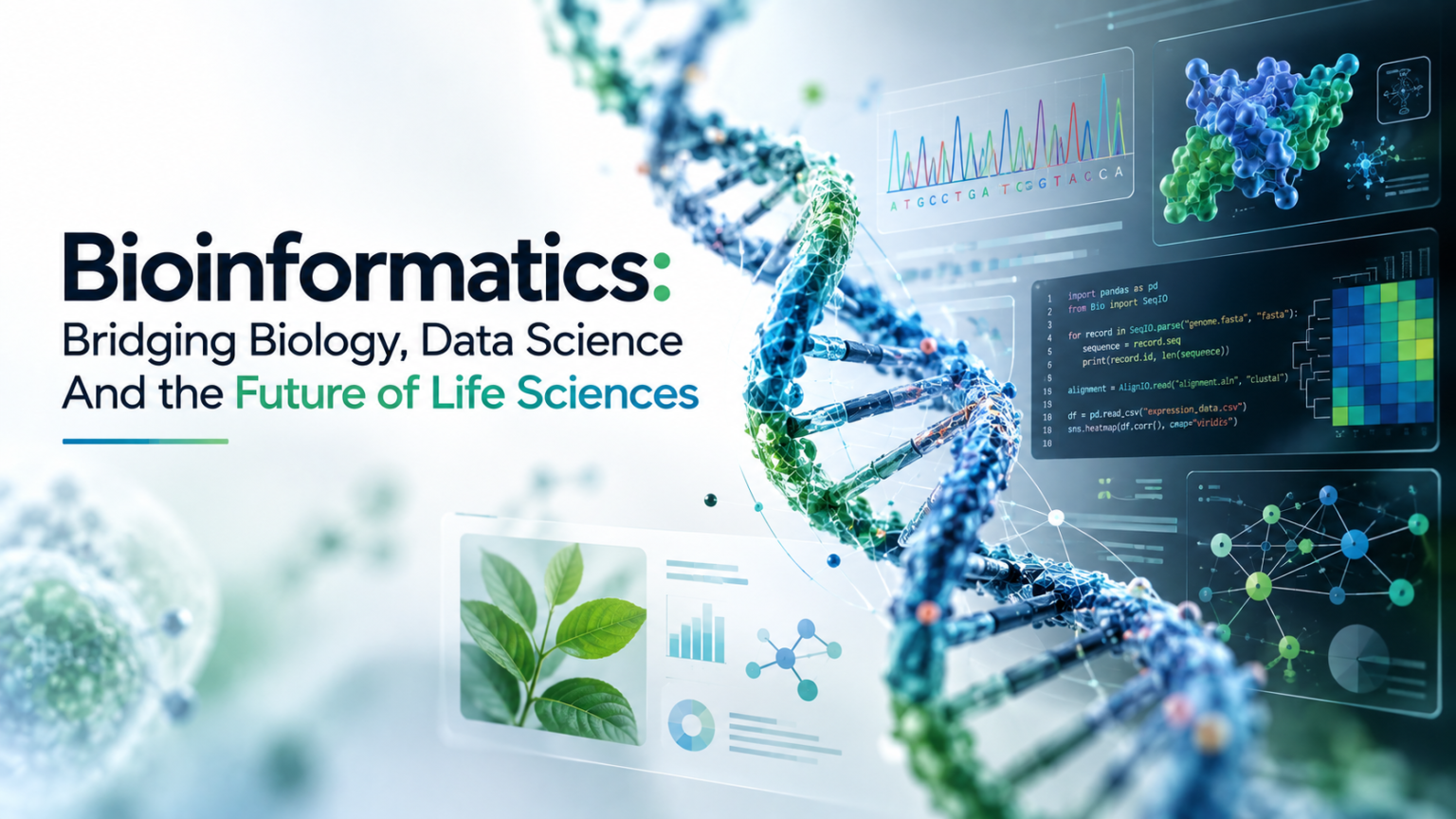
Bioinformatics: Bridging Biology, Data Science And the Future of Life Sciences

Article Summary
As biological datasets continue to grow, bioinformatics is increasingly becoming the bridge between experimental biology and data-driven discovery. At its core, bioinformatics helps researchers answer biological questions using computational approaches. Bioinformatics contributes to proteomics by helping researchers identify proteins from experimental data, predict protein functions, analyse protein interactions, and investigate structural relationships.
Introduction
Modern biology has entered an era defined by data. Advances in DNA sequencing, molecular biology, genomics, proteomics, metabolomics, and high-throughput technologies have made it possible to generate biological information at an unprecedented scale. A single genome can contain billions of DNA bases, while modern experiments can simultaneously produce information about thousands of genes, proteins, and metabolites. Managing, analysing, and interpreting this enormous volume of information requires more than traditional laboratory methods. This is where bioinformatics has become an essential component of modern life science research.
Bioinformatics is an interdisciplinary field that combines biology, computer science, statistics, mathematics, and data science to collect, organise, analyse, and interpret biological data. It enables researchers to transform complex datasets into meaningful biological knowledge and has become fundamental to areas ranging from genome research and drug discovery to agriculture, biotechnology, disease diagnosis, and evolutionary studies.
The importance of bioinformatics extends beyond simply analysing biological sequences. It provides computational approaches for understanding how genes function, how proteins interact, how diseases develop, how organisms evolve, and how biological systems respond to environmental changes. As biological datasets continue to grow, bioinformatics is increasingly becoming the bridge between experimental biology and data-driven discovery.
1. What Is Bioinformatics?
Bioinformatics can broadly be defined as the application of computational and statistical methods to biological data. Although the field initially focused heavily on the analysis of DNA and protein sequences, its scope has expanded substantially with advances in molecular biology and computing.
At its core, bioinformatics helps researchers answer biological questions using computational approaches. For example, scientists may use bioinformatics to compare the genomes of two organisms, identify mutations associated with a disease, predict the structure or function of a protein, analyse gene-expression patterns, or investigate the evolutionary relationships between species.
The field therefore sits at the intersection of several disciplines:
- Molecular and cellular biology provide the biological questions and experimental context.
- Computer science provides algorithms, databases, programming tools, and computational infrastructure.
- Statistics and mathematics provide methods for analysing biological variation and determining whether observed patterns are meaningful.
- Data science and artificial intelligence increasingly support the interpretation of large and complex biological datasets.
This interdisciplinary nature is one of the main reasons bioinformatics has become so important in contemporary research.
2. Why Is Bioinformatics Important?
The rapid development of high-throughput technologies has fundamentally changed biological research. Scientists can now sequence entire genomes, measure the activity of thousands of genes simultaneously, identify large numbers of proteins, and analyse complex biological networks.
Without computational tools, much of this information would be difficult to interpret.
Bioinformatics allows researchers to:
- Store and organise large biological datasets.
- Compare DNA, RNA, and protein sequences.
- Identify genes and other functional genomic regions.
- Detect genetic variations and mutations.
- Analyse gene-expression patterns.
- Predict protein structure and function.
- Study biological pathways and molecular networks.
- Investigate evolutionary relationships.
- Integrate information from different types of biological experiments.
The real value of bioinformatics, however, lies not simply in handling large datasets but in converting biological data into testable scientific insights. Computational predictions can guide laboratory experiments, helping researchers focus their resources on the most promising biological hypotheses.
3. Major Areas of Bioinformatics
Bioinformatics encompasses a wide range of specialised areas. As biological research has become increasingly data-intensive, several major branches have emerged.
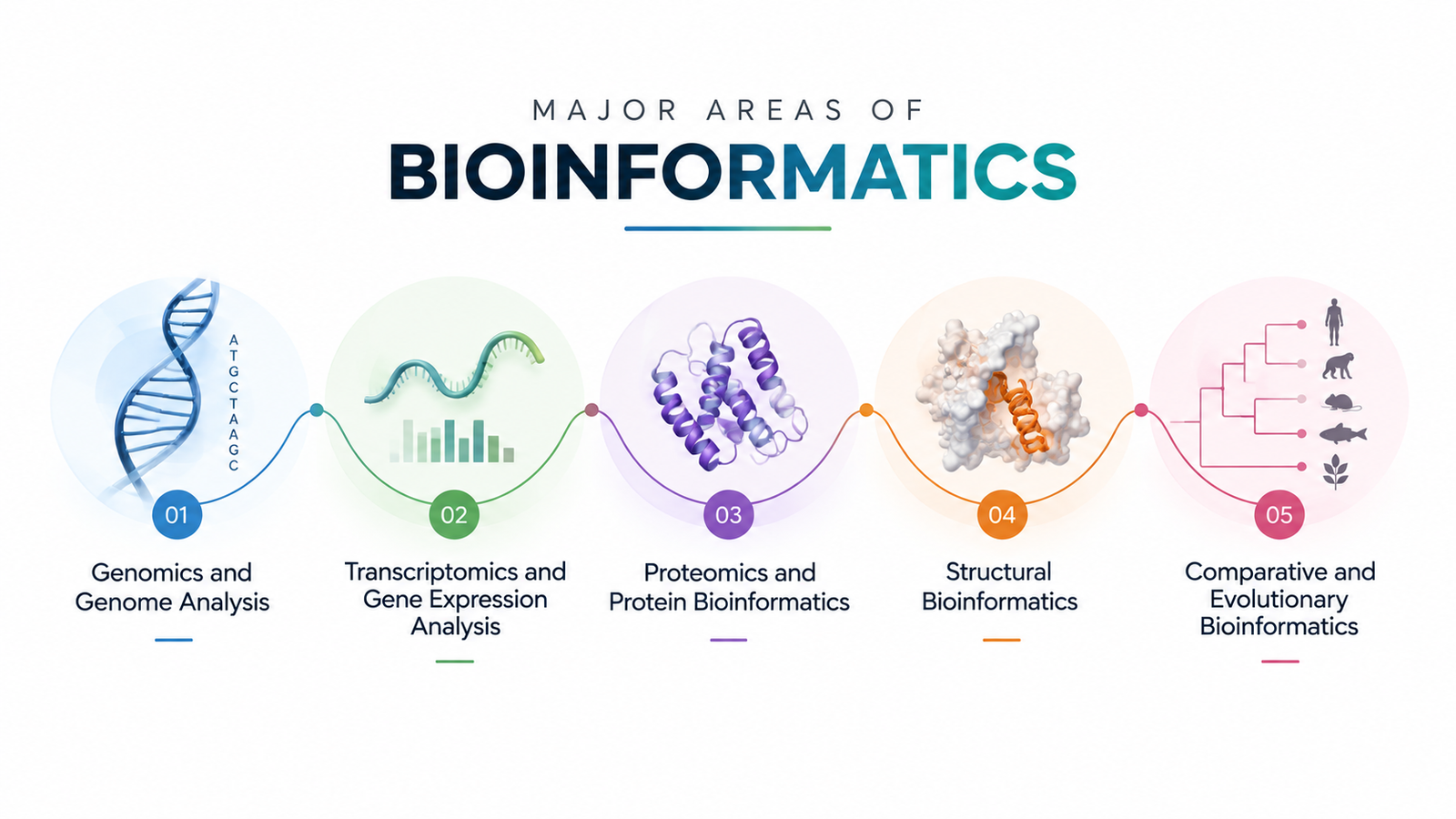
3.1 Genomics and Genome Analysis
Genomics is one of the most important areas of bioinformatics. It involves studying the complete genetic material of an organism and understanding how its genes and regulatory elements contribute to biological characteristics.
Bioinformatics tools can be used to assemble and annotate genomes, compare genomes between species, identify genetic variations, and investigate relationships between genotype and phenotype.
Genome sequencing has become increasingly accessible, allowing researchers to investigate organisms ranging from microorganisms and crops to animals and humans. Computational analysis is essential for converting raw sequencing data into usable genomic information.
3.2 Transcriptomics and Gene Expression Analysis
While genomics focuses on DNA, transcriptomics examines RNA molecules produced by cells. Gene-expression studies can reveal which genes are active under particular conditions and how their activity changes in response to development, disease, environmental stress, or treatment.
RNA sequencing, commonly known as RNA-seq, generates large datasets that require computational processing. Bioinformatics pipelines can help researchers identify differentially expressed genes, discover transcripts, investigate alternative splicing, and explore biological pathways affected by a particular condition.
3.3 Proteomics and Protein Bioinformatics
Proteins perform many of the essential functions within living organisms. Proteomics involves the large-scale study of proteins, including their abundance, modifications, interactions, and functions.
Bioinformatics contributes to proteomics by helping researchers identify proteins from experimental data, predict protein functions, analyse protein interactions, and investigate structural relationships.
Protein structure prediction has become an especially important area of computational biology. Advances in artificial intelligence have significantly expanded the ability to predict three-dimensional protein structures and investigate relationships between protein sequence and function.
3.4 Structural Bioinformatics
Structural bioinformatics focuses on understanding the three-dimensional structures of biological molecules, particularly proteins and nucleic acids.
The structure of a biological molecule often provides important clues about its function. Computational approaches can be used to predict structures, compare molecular shapes, identify functional regions, and study interactions between proteins and other molecules.
Structural information is also highly relevant to drug discovery because researchers can use molecular structures to investigate how potential therapeutic compounds interact with their biological targets.
3.5 Comparative and Evolutionary Bioinformatics
Comparative genomics uses computational methods to compare the genetic material of different organisms. Similarities and differences between genomes can provide insights into gene function, evolution, adaptation, and species relationships.
For example, if a gene is conserved across many species, its biological importance may be inferred from its evolutionary history. Conversely, rapidly evolving genes may be associated with adaptation or specialised biological functions.
Phylogenetic analysis is another important application, allowing researchers to reconstruct evolutionary relationships using molecular sequence data.
4. Bioinformatics in Medicine and Drug Discovery
One of the most important applications of bioinformatics is in biomedical research. Modern medicine increasingly depends on understanding the molecular basis of disease, and bioinformatics provides the computational tools needed to analyse this information.
Genomic analysis can help researchers identify genetic variants associated with diseases and investigate molecular pathways involved in disease development. In cancer research, for example, computational analysis can be used to identify mutations and molecular signatures that distinguish tumour cells from healthy cells.
Bioinformatics is also transforming drug discovery. Computational approaches can assist researchers in identifying potential drug targets, analysing protein–drug interactions, predicting molecular properties, and prioritising promising compounds for laboratory testing.
Major applications include:
- Identification and validation of potential therapeutic targets.
- Analysis of disease-associated genetic variants.
- Virtual screening of candidate compounds.
- Molecular docking and interaction analysis.
- Biomarker discovery.
- Investigation of drug-response mechanisms.
- Support for personalised and precision medicine.
Although computational predictions cannot replace experimental validation, they can significantly reduce the number of candidates that need to be tested experimentally.
5. Applications of Bioinformatics in Agriculture
Bioinformatics is not limited to human health. It has become increasingly important in agricultural biotechnology and crop improvement.
Modern crop breeding generates large amounts of genomic and phenotypic data. Bioinformatics can help researchers identify genes associated with important traits such as yield, drought tolerance, disease resistance, nutritional quality, flowering time, and adaptation to environmental conditions.
Comparative genomics can be used to study relationships between crop species and their wild relatives, while genome-wide association studies can help identify genetic variants associated with desirable characteristics.
Bioinformatics also supports genome editing. Before a CRISPR-based experiment is conducted, computational tools can help researchers identify suitable target sequences and evaluate potential off-target sites. In this way, bioinformatics contributes to the design, analysis, and validation of genome-editing experiments.
The integration of genomics, bioinformatics, phenotyping, and artificial intelligence could therefore accelerate the development of climate-resilient and nutritionally improved crops.
6. Bioinformatics Databases and Biological Resources
Biological databases are among the most important resources in bioinformatics. They provide researchers with access to genomic sequences, protein information, structural data, scientific literature, functional annotations, and other biological information.
Some widely used resources include:
- GenBank for nucleotide sequence information.
- NCBI for a broad range of genomic and biomedical databases and tools.
- UniProt for protein sequence and functional information.
- Protein Data Bank (PDB) for experimentally determined and related structural information.
- Ensembl for genome annotation and comparative genomics.
- KEGG for biological pathways and molecular functions.
These databases allow scientists to compare new experimental results with existing knowledge. They also promote data sharing and reproducibility by providing standardised repositories for biological information.
However, databases are continually updated, and researchers must understand the source, quality, annotation status, and limitations of the data they use.
7. Role of Programming and Data Science in Bioinformatics
Modern bioinformatics increasingly depends on programming and computational analysis. Researchers commonly use programming languages and command-line tools to process biological datasets and develop reproducible workflows.
Python and R are widely used for biological data analysis, while command-line environments are particularly important for processing sequencing data and running bioinformatics pipelines. Statistical programming is essential for analysing experimental results and identifying biologically meaningful patterns.
The growing size and complexity of datasets have also increased the importance of:
- Machine learning
- Artificial intelligence
- Cloud computing
- High-performance computing
- Data visualisation
- Workflow automation
- Reproducible computational research
These technologies allow researchers to analyze datasets that would be difficult or impossible to process manually.
8. Bioinformatics and Artificial Intelligence
Artificial intelligence is becoming increasingly influential in bioinformatics. Biological systems are highly complex, and many datasets contain patterns that are difficult to identify using traditional analytical approaches alone.
Machine-learning models can be trained to recognize patterns in genomic, transcriptomic, proteomic, and structural datasets. Applications include predicting protein structures, identifying disease-associated variants, classifying biological samples, predicting molecular properties, and assisting drug discovery.
However, AI does not eliminate the need for biological expertise. Computational models depend on the quality of their training data and may produce incorrect or biologically misleading predictions. Experimental validation and careful interpretation there fore remain essential.
The future of bioinformatics is likely to involve closer integration between artificial intelligence and biological knowledge, rather than replacing scientific reasoning with automated prediction.
9. Challenges in Bioinformatics
Despite its transformative potential, bioinformatics faces several important challenges. The rapid growth of biological datasets creates substantial requirements for computational infrastructure, data storage, and analytical expertise.
One major challenge is data quality. Poor-quality sequencing data, incomplete genome assemblies, inconsistent annotations, and experimental biases can affect downstream conclusions. Computational sophistication cannot fully compensate for unreliable input data.
Another challenge is reproducibility. Bioinformatics analyses often involve multiple software tools, databases, parameters, and versions. If workflows are not properly documented, reproducing an analysis can become difficult.
Privacy is particularly important for human genomic data. Genomic information can contain sensitive information about individuals and families, requiring careful consideration of data security, consent, governance, and responsible sharing.
Finally, the field requires researchers who can communicate across disciplines. A successful bioinformatician must understand both the biological question and the computational methods being used to address it.
10. Future Scope of Bioinformatics
The future of bioinformatics is closely connected to the continuing expansion of biological data. As sequencing becomes more accessible and multi-omics technologies mature, researchers will increasingly integrate information from genomics, transcriptomics, proteomics, metabolomics, and other biological layers.
This integrated approach, often referred to as multi-omics, can provide a more comprehensive understanding of biological systems.
Future developments are likely to focus on:
- AI-assisted biological discovery
- Personalised and precision medicine
- Large-scale comparative genomics
- Computational drug discovery
- Climate-resilient crop development
- Microbiome research
- Synthetic biology
- Systems biology
- Real-time analysis of biological data
The increasing convergence of bioinformatics with artificial intelligence, biotechnology, and advanced computing could fundamentally change how biological research is conducted.
Conclusion
Bioinformatics has become one of the foundational disciplines of modern life science. By bringing together biology, computer science, statistics, mathematics, and data science, it enables researchers to analyse biological information at a scale that would not be possible through laboratory approaches alone.
From genome sequencing and disease research to drug discovery, crop improvement, evolutionary biology, and synthetic biology, bioinformatics is helping scientists understand increasingly complex biological systems. Its role is particularly important as biological research shifts from generating data to extracting meaningful knowledge from that data.
The future of bioinformatics will depend not only on more powerful algorithms and computing systems but also on better biological data, reproducible research practices, interdisciplinary expertise, and responsible use of sensitive information.
Ultimately, bioinformatics is more than a computational support tool for biology. It is becoming a central framework for discovering, interpreting, and applying biological knowledge in the data-driven era of life sciences.
Key takeaways
- Bioinformatics combines biology, computer science, statistics, mathematics, and data science to analyse biological information.
- It is fundamental to genomics, transcriptomics, proteomics, structural biology, evolutionary studies, and systems biology.
- Bioinformatics plays an important role in drug discovery, disease research, precision medicine, and biomarker identification.
- In agriculture, it supports genome analysis, crop improvement, genetic diversity studies, and CRISPR-based research.
- Biological databases such as NCBI, GenBank, UniProt, PDB, and Ensembl provide essential resources for computational research.
- Artificial intelligence and machine learning are expanding the capabilities of bioinformatics, particularly in protein structure prediction, drug discovery, and biological pattern recognition.
- Future bioinformatics research will increasingly integrate multi-omics, AI, cloud computing, and high-performance computing.
- Reliable biological data, reproducibility, privacy, and interdisciplinary expertise remain critical for responsible bioinformatics research.
Frequently asked questions
1. What is bioinformatics in simple terms?
Bioinformatics is the use of computers, statistics, and data-analysis methods to understand biological information. It helps scientists analyse DNA, RNA, proteins, genomes, and other biological datasets to answer research questions.
2. What are the main applications of bioinformatics?
Major applications include genome analysis, gene-expression studies, protein analysis, drug discovery, disease research, evolutionary studies, agricultural biotechnology, molecular modelling, and precision medicine.
3. Why is bioinformatics important in modern biology?
Modern biological experiments generate enormous amounts of data. Bioinformatics provides the computational methods required to organise, analyse, compare, and interpret these datasets, allowing researchers to convert raw biological information into meaningful scientific insights.
4. How is bioinformatics used in genomics?
Bioinformatics is used to assemble and annotate genomes, identify genes, detect genetic variants, compare genomes, study genetic diversity, and investigate relationships between genetic variation and biological traits.
5. Is bioinformatics used in agriculture?
Yes. Bioinformatics is increasingly used in crop genomics, genetic diversity analysis, marker discovery, genome-wide association studies, molecular breeding, disease-resistance research, and the design and analysis of genome-editing experiments.
6. What programming languages are used in bioinformatics?
Python and R are among the most widely used programming languages in bioinformatics. Researchers also frequently use command-line tools and scripting environments, particularly for processing sequencing data and building computational pipelines.
7. What is the future scope of bioinformatics?
The future of bioinformatics is expected to involve greater integration of artificial intelligence, multi-omics, cloud computing, high-performance computing, and advanced data analysis. These developments could accelerate discoveries in medicine, agriculture, biotechnology, environmental science, and synthetic biology.